
1911 Slides Explained: Slide Types, Slide Stop vs Slide Release, and Long Slides
What a 1911 slide is, what lives inside it, the real difference between a slide stop and a slide release, long slide 1911s, serrations, optic cuts and when to upgrade.
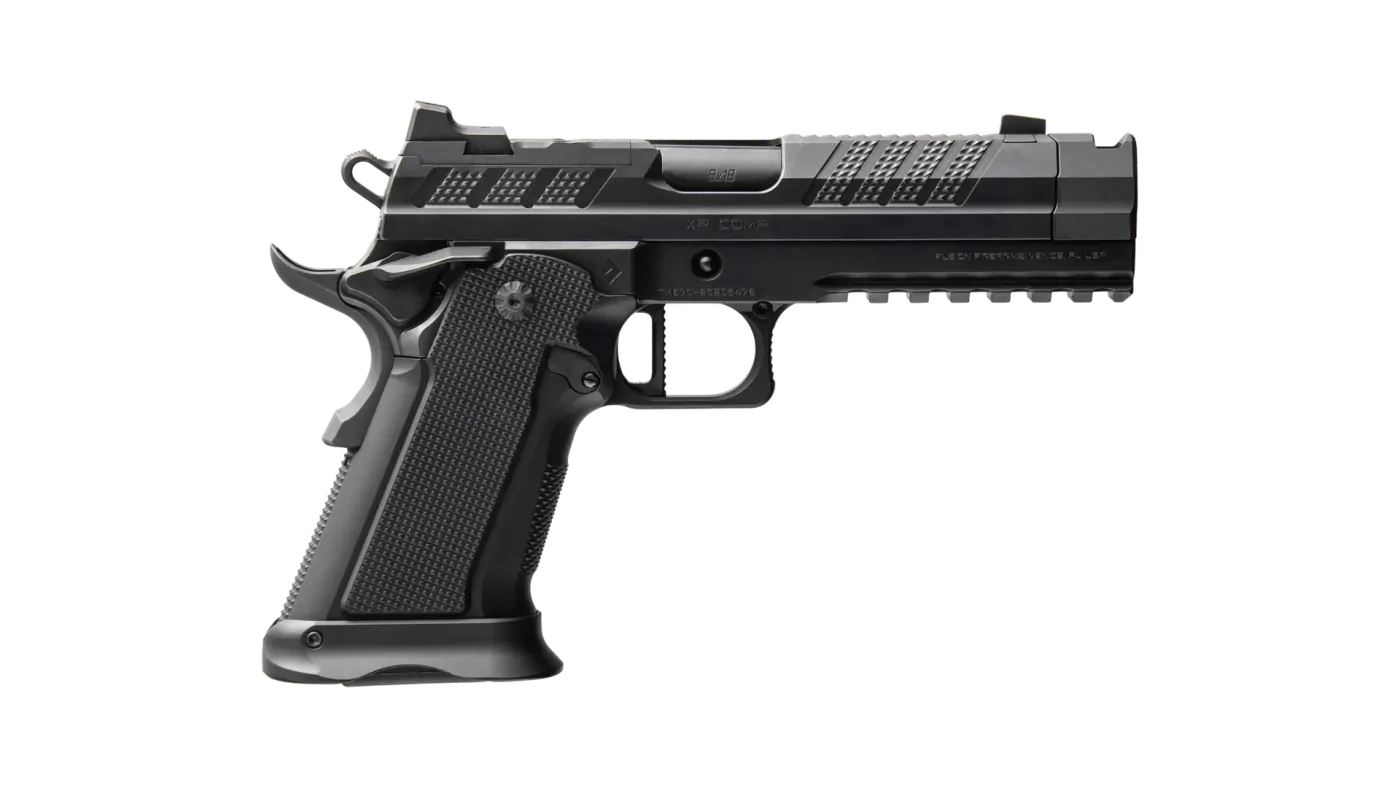
What is a 1911 slide?
Quick answer: a 1911 slide is the reciprocating upper assembly of the pistol. It houses the barrel, firing pin, extractor and ejection port, and cycles rearward under recoil to eject a spent case and chamber the next round.
The slide rides on rails machined into both the slide and the frame. Recoil drives it back, the recoil spring returns it, and the next round is stripped from the magazine on the way home.
1911 slide parts: what is inside
- Extractor: a spring-tensioned claw that grips the case rim and pulls the empty case out.
- Firing pin and spring: the pin strikes the primer, the spring pulls it straight back.
- Firing pin stop plate: retains the firing pin and changes how fast the slide unlocks.
- Sights: dovetailed or staked front and rear sights.
- Ejection port: where the empty case exits, often lowered and flared on custom guns.
Every one of these is available in 1911 slide parts, and the XP-specific versions live under XP PRO parts.
Slide stop vs slide release: what is the real difference?
The confusion comes from mixing up a part with a technique. The part is the slide stop lever. It locks the slide open on an empty magazine, and it can be pressed down with your thumb.
Slide release is what people call the act of pressing it down to chamber the first round. Other shooters prefer to slingshot the slide by pulling it back and letting it go. Both work on a properly fitted 1911.
What is a long slide 1911?
A long slide 1911 uses a barrel and slide longer than the 5 inch Government spec. Fusion builds 6 inch longslides and 7 inch variants for two reasons:
- Sight radius: more distance between front and rear sight makes precise aiming easier.
- Velocity: the bullet gets more barrel to accelerate in, which matters for hunting loads.
Long slides add weight and need a matched recoil spring.
1911 slide lengths at a glance
| Configuration | Barrel | Primary use | Notes |
|---|---|---|---|
| Officer | 3” | Concealed carry | Shortest sight radius, lightest. See the XP 3C for a 3 inch double-stack. |
| Commander | 4 to 4.25” | Daily carry, range | The balance point. The XP PRO V2 is a 4 inch. |
| Government | 5” | Full-size standard | The original spec, most common. |
| Long slide 6” | 6” | Competition, hunting | Extended sight radius. |
| Long slide 7” | 7” | Competition, hunting | Maximum radius, heaviest, needs matched spring. |
Slide serrations and cuts
- Rear-only serrations: the classic arrangement.
- Front and rear serrations: preferred by shooters who press-check.
- Tri-top / anti-glare cut: angled flats that cut reflection over the sights.
- RMR cut: a milled pocket for a Trijicon RMR footprint red dot that sits the optic low on the slide. Our slide work includes RMR and RMSc optic cuts on any 1911.
Upgrading a 1911 slide
Shooters upgrade for three reasons: a different length, a different material (stainless vs carbon steel), or to add optics. You can buy a builder slide and have it fitted, or a fitted slide that installs on a finished pistol. Either way, request a quote and we will fit it correctly.
Frequently asked questions
What is the difference between a slide stop and a slide release?
There is only one part: the slide stop. Slide release describes the technique of pressing that lever down to send the slide forward.
What is a long slide 1911?
Any 1911 with a barrel longer than the 5 inch Government standard, typically 6 or 7 inches. The longer sight radius and extra velocity make them popular for competition and hunting.
Can I swap a 1911 slide myself?
Slide-to-frame fit and barrel indexing need gunsmith-level fitting. A fitted slide from our shop installs directly; a builder slide needs to be fitted.